

The market demand for affordable, regulator-ready ARV generics continues to grow, yet many molecules remain difficult to formulate and scale. One such molecule, Etravirine, presented thermal sensitivity, solubility and stability hurdles that made conventional approaches risky and resource-intensive. Using STEER’s solvent-free FragMelt™ continuous hot-melt fusion platform, STEERLife applied DoE, defined critical process parameters, produced consecutive commercial batches, and developed a robust amorphous solid dispersion (ASD) without using organic solvents. A biorelevant dissolution method was established when the USP/OGD method proved non-discriminatory. Impurity risks (including N-nitroso) were managed per ICH guidance. The program delivered bioequivalence (fed & fasted), met ICH impurity limits, supported ANDA approval, and validated FragMelt™ as a scalable, regulator-ready route for complex generics. This case study outlines how STEERLife executed this innovation-driven project to enable the development and manufacturing of generic Etravirine Tablets not just with a difference but key differentiators as well. This end-to-end development project was executed for a partner in North America, resulting in a successful ANDA approval for the drug product despite notable differences from the RLD product both in terms of processes and in-vitro product performance. Download case study
How Polymer Selection and Process Design Shape Successful ASD Development
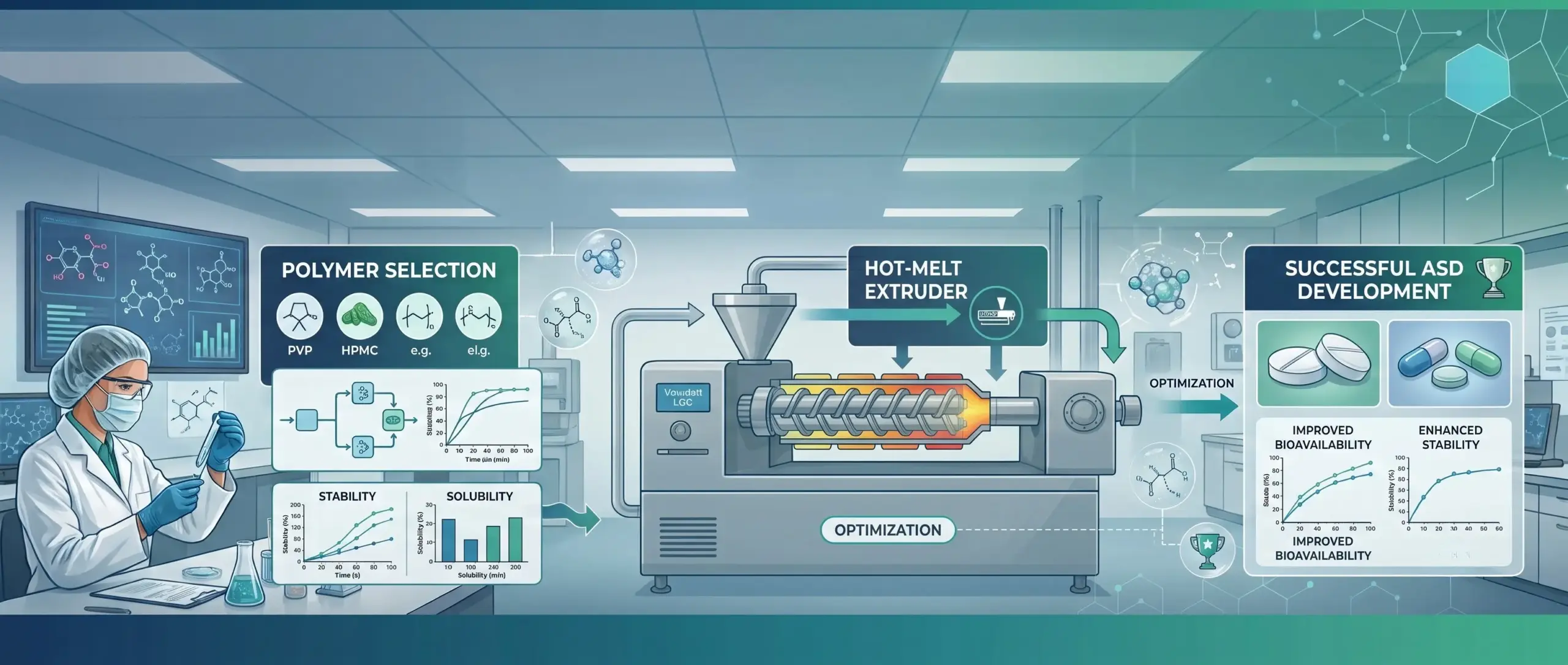
Dr. Vinay Rao VP – R&D & Head – Center of Excellence The pharmaceutical industry is increasingly challenged by drug molecules with poor aqueous solubility. A large proportion of modern active pharmaceutical ingredients (APIs) fall into BCS Class II and IV categories, where dissolution and bioavailability become critical barriers to successful oral delivery. While these molecules may demonstrate excellent pharmacological activity, converting them into effective and manufacturable do sage forms remains a significant formulation challenge. Among the various bioavailability enhancement approaches available today, amorphous solid dispersions (ASDs) have emerged as one of the most effective and widely adopted strategies. By dispersing the drug in an amorphous state within a polymer matrix, ASDs can significantly improve apparent solubility, dissolution rate, and oral absorption. However, successful ASD development is rarely driven by formulation composition alone. In practice, there are factors such as the interaction between polymer selection, process design, and manufacturability ultimately determines long-term product performance. The Role of Polymers in ASD Systems Polymers serve a far greater purpose in ASD systems than simply acting as inert carriers. Their properties directly influence: Amorphous stabilization Supersaturation maintenance Recrystallization inhibition Moisture sensitivity Processability Long-term physical stability Commonly used ASD polymers such as HPMC-AS, HPMCP, PVP, copovidone, and Soluplus® each offer distinct advantages depending on the API and formulation objective.For example: Cellulosic polymers are often selected for strong precipitation inhibition and enteric functionality. PVP-based systems may offer excellent miscibility and processing ease. Functional graft copolymers can support enhanced solubilization for highly lipophilic compounds. At the same time, polymer properties such as glass transition temperature (Tg), hygroscopicity, melt viscosity, and thermal stability strongly impact process feasibility during hot melt extrusion (HME). In many cases, polymers that provide superior amorphous stabilization may also present processing challenges due to high melt viscosity or thermal sensitivity. As a result, amorphous solid dispersions development requires balancing bioavailability enhancement with manufacturability and stability considerations. Why Hot Melt Extrusion Has Become Important Hot melt extrusion has evolved into a key enabling technology for ASD manufacturing because it combines melting, mixing, and dispersion into a continuous solvent-free process. Compared to traditional solvent-based approaches, HME offers several advantages: reduced or eliminated solvent usage, continuous processing capability, controlled thermal and mechanical energy input, shorter processing times, improved scalability, and easier integration with continuous manufacturing platforms. The ability of HME to generate intimate molecular mixing between API and polymer under controlled process conditions makes it particularly valuable for poorly soluble molecules. However, successful ASD processing through HME requires more than simply selecting the right polymer. The Importance of Process Design in ASD Manufacturing One of the most critical aspects of amorphous solid dispersions development is the interaction between material properties and process conditions. During HME, the formulation is exposed to: Thermal energy Mechanical shear Pressure Residence time Mixing intensity These variables directly influence: Amorphization efficiency Degradation pathways Impurity formation Melt homogeneity And final product performance For example: Excessive thermal exposure may increase degradation risk for thermally sensitive APIs High specific mechanical energy (SME) may improve amorphization while simultaneously increasing impurity generation. Inadequate mixing may result in residual crystallinity and poor content uniformity. Similarly, screw configuration design plays an important role in balancing distributive and dispersive mixing while maintaining stable melt transfer through the process. As ASD systems become increasingly complex, successful development requires an integrated understanding of both formulation science and process engineering. Bridging Development and Manufacturability in ASD Programs One of the key challenges in ASD programs is translating early formulation success into robust commercial manufacturing. Laboratory-scale systems may demonstrate strong dissolution enhancement under optimized conditions, but frequently encounter challenges associated with: Thermal sensitivity of API s and polymers Downstream processability constraint Milling and particle-size behavior Compression characteristics Long-term physical and chemical stability This highlights the importance of selecting hot melt extrusions platforms capable of providing: Controlled thermal environments Flexible process architecture Scalable screw design Precise feeding systems Advanced process monitoring capabilities. Ultimately, successful ASD development depends not only on polymer functionality, but also on the ability to align formulation behavior with process design and commercial manufacturability. Conclusion Amorphous solid dispersions continue to play a transformative role in enabling oral delivery of poorly soluble molecules. While polymer selection remains central to ASD performance, the success of these systems increasingly depends on how formulation science interacts with process design and manufacturing strategy. As pharmaceutical molecules become more complex, the future of ASD development will require a more integrated approach, one that combines material science, process understanding, and scalable continuous manufacturing principles to create robust and commercially viable drug delivery solutions.